
The Disillusionment Phase: Why falling out of love is supposed to happen
Spoiler: it doesn't mean it's time to leave.

The acceptance of the death of illusion is a necessary step in the transformation of romantic love to mature love.
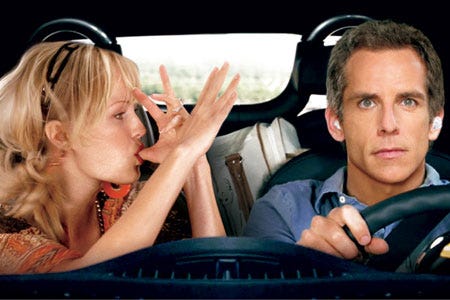
Whenever a new relationship starts, and you both feel it, it’s the best. It’s awesome. You love spending time together. You are crushing on each other. You think about them while at work. You may even idealize (or even over-idealize) them, i.e., she is the prettiest, kindest, and coolest woman in the entire world.
And, that’s okay. You are falling for each other. We fall.
🎬 Watch “The Heartbreak Kid” (2007): Let’s take the plunge scene
I have been there. In one relationship, I was convinced I was dating a “genius,” and in those first few months, I would list his credentials and scholarships to just about everyone. It was exhausting for people to listen to me cite his curriculum vitae at every dinner party. Another time, I was sure that my boyfriend was not just funny but was the funniest person on the planet, but rest assured, Adam Sandler is my favorite comedian again.
🎬 Watch this “Billy Madison” clip (1995): I dare you not to laugh.
The more we idealize our romantic partners ( “they are my soulmate”), the more we stay in that relationship, so maybe there is a reason we naturally do this. There may even be some sort of biological, pre-programmed part of our brain that does this, so we stick around, reproduce, and get through the tough times, because if we put our love on a pedestal, we will certainly stay. A few psychological research studies even confirm this (see Personal Relationships).1

If you think no one will ever get the real you except this one person, then why would you break up?2 We even play mind games where we give positive credit for behaviors like paying for dinner or calling every day, but we make excuses for bad behavior, like that he drinks too much or that he isn’t allowed to see his kids.3 We might rationalize, “It is not his fault; it is because he told me his ex-wife is crazy.” When we idealize our romantic partner, we see and hear only what we want to.4
Once our dopamine, oxytocin, and phenylethylamine levels decline, which can be 6 months, 8 months, 1 year, or even 2 years, the disillusionment rolls in. Their immaculate persona fades. Mr. Nice Guy can become resentful and contemptuous. Ms. Nice Gal can become exhausted and emotionally detached.
🎬 Watch this clip from “Over Your Dead Body” (2026) all the way through to the end.
Disillusionment is the abatement of love, a decline in overt affection, a lessening of the conviction that one’s spouse is responsive, and an increase in ambivalence.
When we become disillusioned in our relationships, we see their shortcomings…. we find things wrong with them. We don’t really like them.
*I am not talking about infidelity or abuse of any kind – that is something else and is not considered the “disillusionment phase,” but a major break in trust and personal safety. Rather, I am talking about when they appear not as amazing as you thought. I am talking about vulnerability, personality differences, and compatibility issues.
Did they snore before? Were they always so angry? Are they a narcissist? Did they always have so many problems? Are they anxiously attached? Why didn’t I see that before?
Does every couple go through disillusionment?
I am so glad you asked. The answer is yes, and every long-term couple goes through what relationship expert Terry Real calls the “disillusionment or disharmony phase.”
Now, here is the important part: Disillusionment does not mean the relationship is bad or that it’s time to break up.
It is important that you read that again.
Disillusionment does not mean the relationship is bad or that it’s time to break up.
Disillusionment/disenchantment/disharmony/disaffection/disappointment can be an essential cognitive and behavioral process in the growth into mature love and, to be fair, a natural reaction of our minds to idealization.5 This is when it is especially important to be compassionate with yourself and your partner.
🎬 This is one of my favorite clips from “The Heartbreak Kid” (2007):
🔖Case Study: Susanah is a tall, good-looking, smart, independent woman in her late 30s who has never been married or had children, but she wants children more than anything and wants to find “the one.” She has frozen her eggs and taken all the preparations to have them later in life with the man of her dreams. She admits she has been a workaholic for much of her life (“married to her career”), but now she really wants to focus on finding someone to start a family with. She is on all the apps and goes out at least once a week. She is open. Then, she met someone from her past who was divorced. She was so excited because she had always had a crush on him before he was married. He has two kids in high school, is smart and kind, has a great job, and is a great father. She was beyond excited. Every moment they were together was electric. Almost immediately, they were in the honeymoon phase of dating. This could be the one, she thought. She introduced him to her parents. She took him out to meet all her friends and met his. They run away on a few romantic vacations together. She even meets his kids and adores them. Then, around 7 months, when they were easily seeing each other 3-5 times a week, she started to get the icks.
You know what the icks are? It’s a slang term from “a sudden, visceral feeling of disgust or repulsion toward a romantic partner, triggered by a specific, often trivial behavior.” It’s when disillusionment seeps in.
This was not new for her either. Most of her relationships lasted 8 months, and she had a pattern of suddenly feeling, around that time, that things would just not work. She started to feel jealous of his children. It is as if she just realized that his children will always come first. It would be better, she thought, to have someone who didn’t have kids. That must be the problem, so she had dinner with him and told him, “I really like you, and you check all the boxes, but one. I want someone who has never had children. I want to be the one you have kids with first.”
